


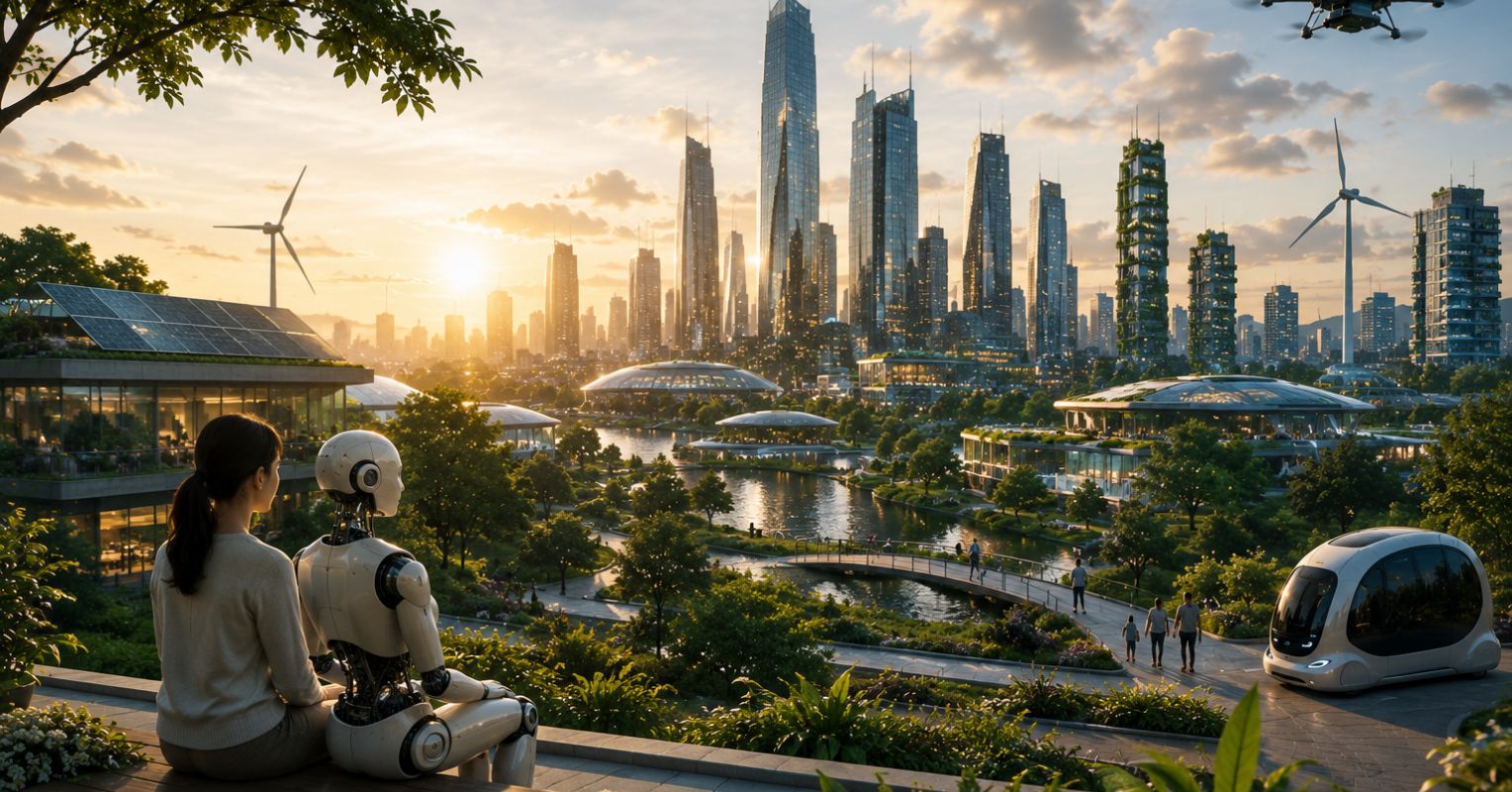
For years, the promise of technology has sounded almost magical: smarter factories, faster decisions, automated services, personalized medicine, self-driving systems, and artificial intelligence that can process more information than any human ever could. But beneath all that excitement sits a quieter question: Will any of this actually make human life better?
That question is at the heart of a growing conversation around Relationships 5.0, Society 5.0, and Industry 5.0. Society 5.0, first promoted in Japan, envisions a “super-smart” society in which digital systems and physical life are deeply connected, with human well-being at the center. Industry 5.0, advanced especially by the European Commission, builds on Industry 4.0 but shifts the focus from efficiency alone to a more sustainable, resilient, and human-centered economy.
A recent article in Business and Society Review, “Society 5.0—Aiming for a super smart society through Industry 5.0,” argues that these two ideas belong together. Industry 5.0 can provide the technological foundation – AI, robotics, big data, digital twins, smart materials, and advanced networks – while Society 5.0 supplies the broader social goal: technology that supports inclusion, sustainability, health, and quality of life.
The shift matters because the previous industrial vision, Industry 4.0, was largely built around automation, productivity, and smart manufacturing. That brought enormous gains, but also understandable anxieties: job displacement, data privacy, surveillance, skill gaps, and a work culture in which people may feel they are adapting to machines rather than the other way around.
Industry 5.0 tries to correct that imbalance. The European Commission describes it as complementing Industry 4.0 by placing research and innovation in the service of a sustainable, human-centric, and resilient industry, one that moves beyond shareholder value toward wider stakeholder value. In plain language: The machine should not be the main character. People should be.
The psychological stakes of a “super-smart” society
It is tempting to treat Society 5.0 as a technical idea. But it is also a psychological one. A society filled with sensors, AI systems, predictive analytics, and automated services will shape how people feel about autonomy, competence, privacy, fairness, and belonging. Technology can reduce burdens, but it can also create new ones.
A smart healthcare system, for example, could use wearable devices and AI to detect risks early and personalize care. That could save lives. But if poorly designed, it could also make people feel constantly monitored. Similarly, a smart workplace could use collaborative robots, or cobots, to take over dangerous and repetitive tasks. That could protect workers and free them for more creative work. But if implemented without trust and training, it could fuel fear, loss of status, and job insecurity.
A smart city could improve transportation, energy use, disaster response, and public services. But if access is unequal, it may simply create a polished digital world for some and a frustrating maze for others. The OECD notes that digital divides still appear across geography, education, age, income, and firm size. This is why the human-centered promise of Society 5.0 cannot be treated as decorative language. It has to be designed into the system.
The danger of “efficiency without empathy”
A major lesson from Industry 4.0 is that efficiency is not the same as well-being. A workplace can become faster and more automated while employees become more anxious. A city can become more connected while residents feel more watched. A healthcare system can become more data-rich while patients feel less personally understood.
The research article highlights several risks that need serious attention: work polarization, privacy concerns, data security, unequal access to technology, regulatory gaps, and the challenges of human-robot interaction. These are not side issues. They are central to whether Society 5.0 becomes genuinely human-centered or merely more technologically sophisticated.
Work-life balance is especially important. If digital systems make work follow people everywhere, then “smart” tools may quietly increase burnout. The World Health Organization and International Labour Organization estimated that long working hours were linked to 745,000 deaths from stroke and ischemic heart disease in 2016, a stark reminder that work design is also health design. A humane version of Industry 5.0 would ask not only, “Can this be automated?” but also: Should it be automated? Who benefits? Who is burdened? What happens to dignity, meaning, and mental health?
The new human-machine relationship
One of the most interesting promises of Industry 5.0 is not replacing humans with machines, but redesigning collaboration between them. In this model, robots handle repetitive, hazardous, or physically demanding work. Humans contribute judgment, creativity, empathy, ethics, and contextual intelligence. AI may help identify patterns, but people still decide what those patterns mean and what values should guide action.
That sounds ideal, but it requires more than new tools. It requires new forms of education, leadership, and organizational culture. People need to understand the systems they work with. Workers need reskilling opportunities before, not after, their roles are disrupted. The World Economic Forum’s Future of Jobs Report 2025 identifies technological change, demographic shifts, economic uncertainty, and the green transition as major forces reshaping labor markets through 2030.
The psychological contract between employers and employees may also need to change. If organizations adopt AI and robotics while telling workers, “Just keep up,” anxiety will rise. But if they say, “We will help you grow with these tools,” the same transition can feel less threatening and more empowering.
Trust is the infrastructure
Society 5.0 depends on data. Lots of it. Health data, mobility data, work data, education data, energy data, consumer data—the whole vision rests on information flowing across systems. That makes trust essential. People will not embrace smart systems if they believe those systems are opaque, unfair, insecure, or exploitative. This is where governance matters. Frameworks such as the NIST AI Risk Management Framework are part of a broader effort to make AI systems more trustworthy and responsible.
Trust also depends on participation. People are more likely to accept technological change when they have a voice in how it is implemented. A human-centered society cannot be built only by engineers, executives, or policymakers. It needs workers, patients, teachers, caregivers, older adults, people with disabilities, rural communities, and marginalized groups involved from the beginning. Otherwise, Society 5.0 risks becoming a society designed for people without being designed with them.
What would make Society 5.0 psychologically healthy?
A psychologically healthy Society 5.0 would not measure success only by productivity, speed, or economic growth. It would also ask whether technology helps people live with more autonomy, connection, fairness, safety, and meaning. That means smart healthcare should feel caring, not cold. Smart education should personalize learning without reducing students to performance dashboards. Smart transportation should expand mobility, not deepen inequality. Smart workplaces should reduce drudgery and danger, not intensify monitoring. And perhaps most importantly, smart cities should make life more livable, not merely more measurable.
The promise of Society 5.0 is not that technology will solve every social problem. It will not. Technology reflects the priorities of the people and institutions that design it. The real promise is more modest and more powerful: We can choose to build systems where innovation serves human flourishing rather than the other way around. That choice will determine whether the next technological era feels like liberation or just another upgrade we are all expected to survive.
