


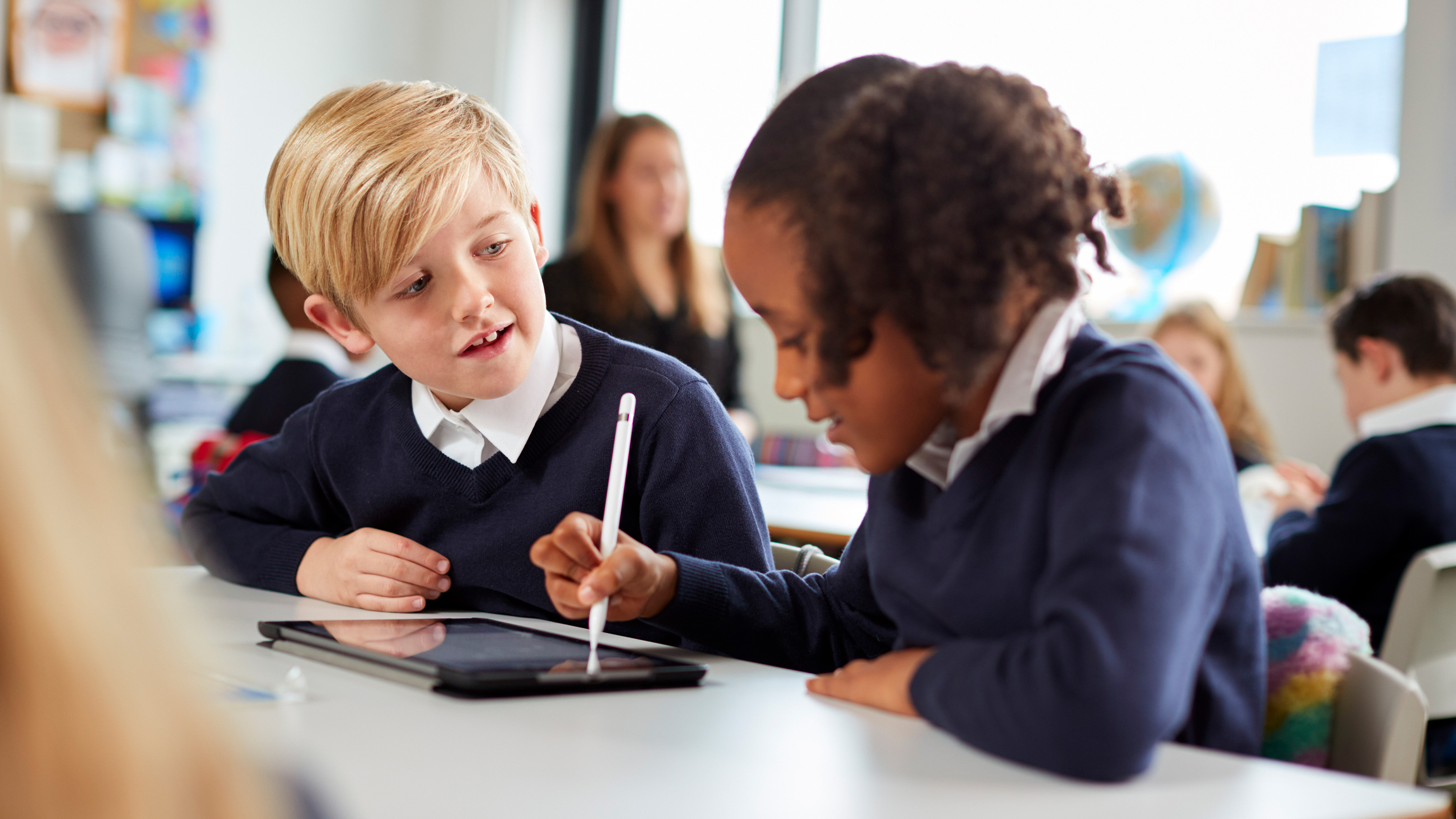
In traditional math classrooms, students are often expected to report answers rather than explain their mathematical reasoning. Brief responses directed toward the teacher can limit opportunities for students to make sense of ideas, learn from peers, and communicate their thinking.
Encouraging students to explain their thinking helps them make sense of new mathematical concepts, learn from peers, and communicate what they know. These opportunities are especially important for multilingual learners, who develop language fluency through meaningful opportunities to speak, write, and discuss ideas in the languages they are learning. That means that teaching students how to explain their thinking helps them strengthen their math skills and their language skills at the same time.
As professional development facilitators who support mathematical discourse in elementary classrooms, we encourage teachers to create structures that help students share and reflect on their mathematical thinking. Digital tools can expand opportunities for students to explain their reasoning through speaking, writing, drawing, and peer conversation. Tools such as audio and video recordings allow students to communicate their problem-solving strategies independently or with a partner, while giving teachers deeper insight into how students are making sense of mathematical ideas. When used intentionally, technology can support meaningful mathematical discourse and help make student thinking more visible.
Multimodal Explanations
Teachers can use digital tools such as Seesaw to create additional opportunities for students to explain and reflect on their mathematical thinking. For example, when students solve equal-sharing fraction problems, teachers can invite them to record their strategies electronically using drawings, writing, images, audio, or video. These multimodal explanations encourage students to communicate not only their answers, but also their reasoning processes.
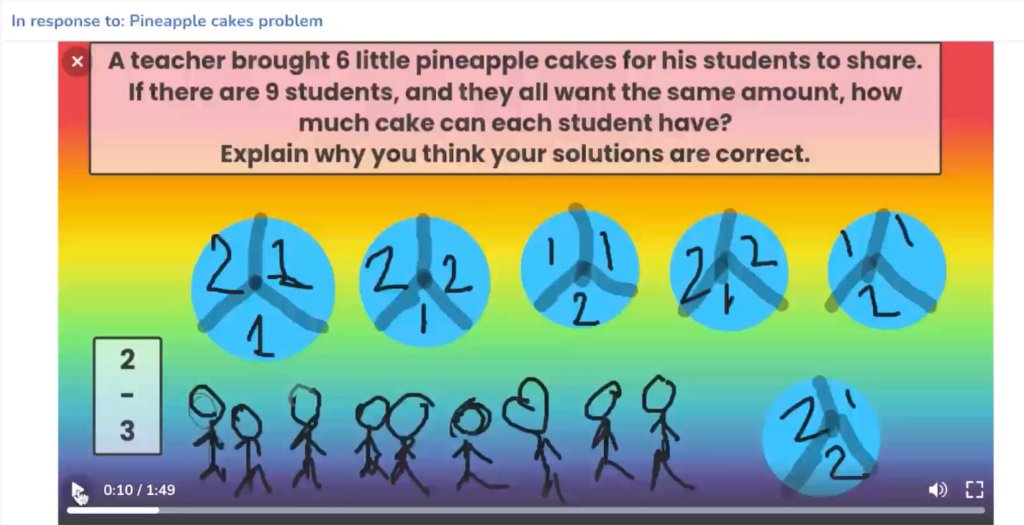
Created with Seesaw
As students verbally explain their thinking, teachers gain a deeper sense of how the student is making sense of fraction concepts. Some students may use guess-and-check strategies, such as distributing halves to each sharer, while others may anticipate how many equal parts each person should receive before partitioning. Listening to students describe their reasoning helps teachers identify how students understand fairness, equal partitioning, and fraction relationships in ways that may not be visible in written work alone.
Recording explanations can also support students in their own sense making. When students are encouraged to explain their reasoning aloud, they have opportunities to clarify, revise, and reflect on their mathematical ideas. These opportunities are especially valuable for multilingual learners because they allow students to simultaneously develop conceptual understanding and academic language fluency through authentic mathematical communication.
Partner interviews
Teachers can extend mathematical discourse through structured partner interviews, where students explain and question one another’s problem-solving strategies. After independently solving an equal-sharing fraction problem, students can work with a partner using a simple interview script that prompts them to describe their strategy, justify their reasoning, and ask clarifying questions. These conversations help students make sense of mathematical ideas while learning from peers’ approaches.
Technology can support this process by allowing conversations to be audio or video recorded using classroom devices such as tablets or iPads. Teachers can select a small number of focus students at varying English language proficiency levels to monitor their progress over time. Using an iPad, teachers can record the students’ conversations during the structured partner interviews. Teachers can use the recordings of a few particular students to see how they’re using mathematical language in the beginning of the year compared with the end, and how to support those individual learners along the way (e.g., using the term fourth instead of piece). Recording a select group of focus students makes the reflection process manageable so that teachers can learn how students are expressing their mathematical ideas and practicing reasoning routines.
Teacher adaptation and feedback
Watching post-lesson videos aligns with Cognitively Guided Instruction (CGI), which promotes the idea of using students’ individual solution strategies, either written or verbal, to determine what students know. By figuring out how students are currently making sense of the new concepts and using language specific to math, teachers can use these patterns to determine their next instructional steps, such as how to pair students up or which math problem they’re ready for next.
Recordings from focus students can also capture students’ full linguistic repertoires in greater detail. Teachers may review short segments after the lesson, revisit particular student explanations, or use recordings to notice patterns in student thinking and language use that inform future instruction (pairing students with different strategies or choosing the next problem for them to solve).
These recordings can also support student reflection by allowing learners to revisit and refine their explanations over time. For multilingual learners especially, partner interviews provide meaningful opportunities to practice mathematical language, explain ideas using familiar language resources, and engage in authentic mathematical conversations with peers.
When students record their thinking both visually and verbally, teachers can gain deeper insight into students’ mathematical understanding than from written work alone. These multimodal opportunities allow students to revisit and refine their explanations, engage with peers’ strategies, and make their thinking visible. Teachers can use these explanations to identify misconceptions, notice emerging mathematical ideas, and plan follow-up instruction that builds on students’ thinking.
Linguistic flexibility for multilingual learners. Language plays a powerful role in shaping students’ mathematical sense making. When multilingual students drew on their full linguistic repertoires, their language practices became a resource when learning new content knowledge. In both the individual (Seesaw) explanations and the peer conversations (partner interviews), some students used multiple languages (Spanish and English) to explain their thinking! This flexibility is an asset because using multiple languages allows people to think about math in multiple ways. Also, learners can clarify their math ideas more precisely when they get to use the languages that they are most familiar with.
Practicing writing and speaking helps students, especially multilingual students, learn how language works to communicate mathematical ideas. Encouraging students to share their mathematical thinking—whether through digital tools, structured conversations, or both—does more than increase participation. It helps students develop deeper understanding, strengthens communication skills, and positions their ideas as central to the learning process. It helps deepen their mathematical understanding and strengthens their academic language and English language fluency at the same time.
When teachers make space for students to explain, question, and reflect, they create classrooms where all learners can engage meaningfully with mathematics and with one another.
