


Insurance carriers have always relied on data to understand risk. What has changed dramatically, however, is how that data is used.
Processing Content
Most carriers in the industry have moved away from manual reviews of raw reports to standardized summaries known as attributes and are now evolving toward neural networks and embeddings. The goal is the same as it’s always been: making decisions that are faster, more consistent and better at predicting outcomes.
Early underwriting was largely manual. Underwriters reviewed motor vehicle reports line by line, looking for violations such as DUIs or speeding tickets. They weighed the timing, location and severity of each incident to understand the risk. While intuitive, the approach was subjective. Two underwriters could review the same report and reach different conclusions, leading to inconsistent decisions based on individual judgment.
To reduce that variability, the insurance industry began to use attributes to automate manual underwriting tasks.
Attributes are standardized summaries of raw data that answer specific questions. How many violations have occurred in the last three years? What is the total credit utilization on a file? Some attributes are simple, like a driver’s age. Others require complex calculations across years of historical data, such as the percentage of time a driver maintains full coverage. Our team builds thousands of these attributes to turn complex raw data into clear, usable information for the insurance industry. Attributes have enabled carriers to build models faster and more reliably from structured data, accelerating their ability to predict insurance events such as likelihood to shop, future loss propensity, fraud, retention and more.
As data inputs became more sophisticated, so did the models used to analyze them. Early rules-based systems gave way to generalized linear models (GLMs), which could reliably use attributes to predict outcomes. More recently, machine learning techniques such as gradient boosting machines (GBMs) have enabled carriers to handle more variety in data sources and more complexity in data such as nonlinearity and high-order interaction among variables.
However, these models still struggle with complex relationships over time, space and across various types of data. For example, a specific sequence of events like a customer missing a mortgage payment, then an auto loan payment, followed by applying for two credit cards might indicate significant risk. A GLM or GBM would detect this pattern only if a data scientist anticipated it and created a dedicated attribute, an approach that can be impossible to perform at scale.
What if data scientists didn’t need to generate every possible attribute? What if models could identify the most meaningful patterns on their own? Modern neural networks make this possible.
Rather than relying on hand-crafted summaries, they can analyze all data points and learn complex relationships directly. When a neural network learns data, it develops an internal representation known as embedding. You can think of an embedding like a map coordinate: just as latitude and longitude describe a physical location, an embedding uses hundreds of numerical values to place data points into a mathematical space. In that space, data with similar meanings or behavior naturally sit closer together.
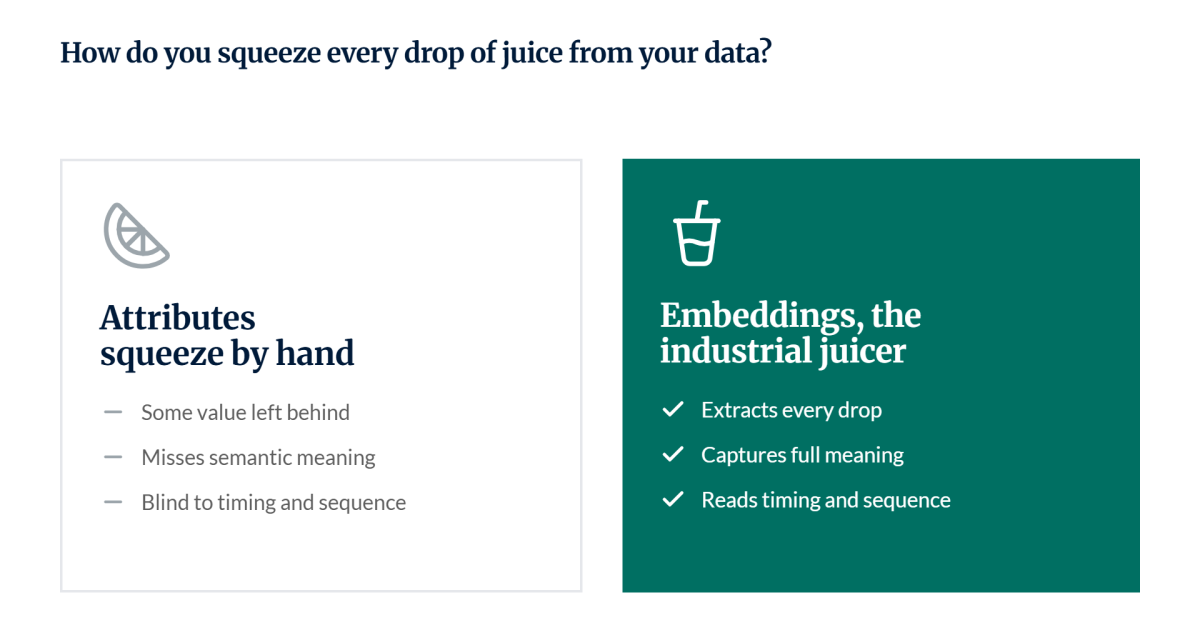
One useful way to think about the difference between attributes and embeddings is to picture data as an orange. Attributes are like squeezing it by hand: you get some juice, but a significant amount is left behind. Embeddings, by contrast, are like industrial juicers. They extract every drop. Embeddings capture the full richness of the data, including semantic meaning, timing and sequences, which standard attributes often miss. This “super attribute” capability allows for a much deeper understanding of risk.
Models trained on general internet text or images are not built to handle the structure and nuance of insurance data. For that reason, our team is developing embedding models designed specifically for the insurance industry.
Once generated, these embeddings are incredibly versatile: they can be used across multiple models to support predictions related to loss propensity, severity, customer churn and other insurance related events. This technology is already at work in approaches where embedding-based models help anticipate future property losses. As the industry continues to move beyond simple summaries toward deeper, data-rich representations, carriers will be better positioned to manage risk with greater confidence and precision.
The next article in this series will take a deeper look at embeddings: why they matter, how they work, and what they enable for insurance risk modeling.
