


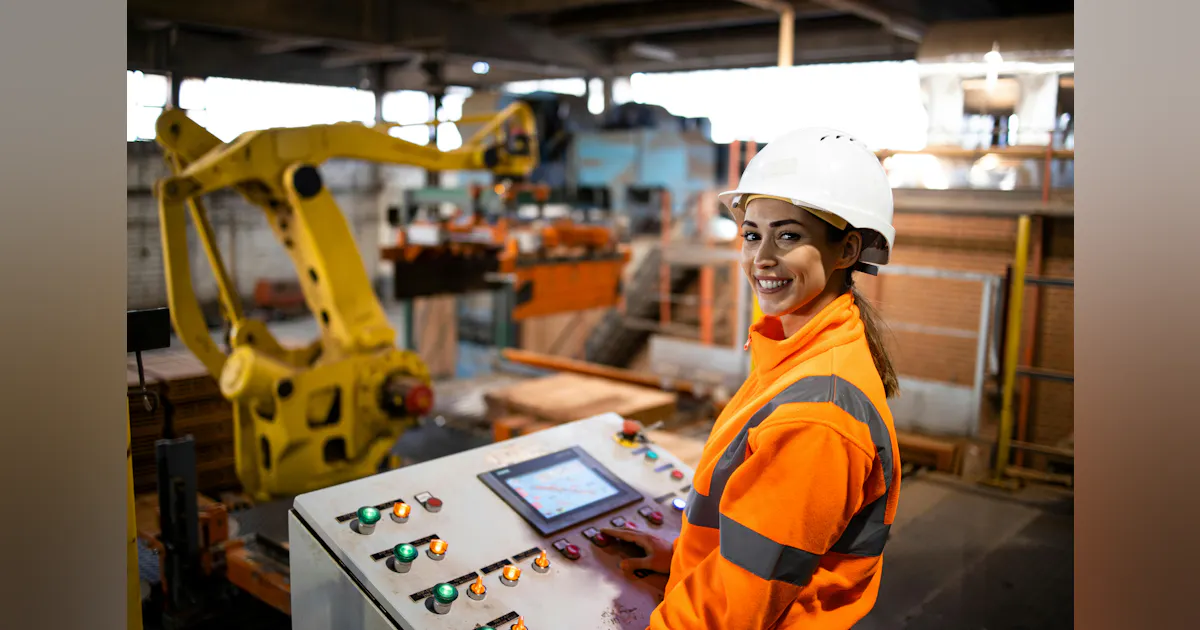
The manufacturing industries continue to face a labor shortage challenge, with hundreds of thousands of positions remaining unfilled. While automation is often viewed as a threat to employment, a different reality is emerging on factory floors. Manufacturers and system integrators are finding that strategic automation deployment addresses critical pain points, from repetitive welding tasks to ergonomically hazardous operations, while simultaneously creating more engaging roles for workers.
In this Automation World conversation with Austin Levin (AL), lead automation engineer with system integrator ACS, we discuss how manufacturers are using technologies like collaborative robots and machine tending automation to tackle safety concerns, improve worker retention and attract new talent to an industry working to shed its reputation as being dull, dirty and dangerous.
AW: Let’s start with a statement we’ve all heard before, which goes something like this: “Automation doesn’t eliminate jobs in manufacturing, instead it helps move people into different positions more suited to humans than the drudgery of repeated and or difficult tasks that automation can handle.” Are you seeing this to be true? And, if so, can you describe a situation where automation enabled the redeployment of workers to higher value roles?
AL: Yeah, that’s a really important topic with the modern automation landscape and we see it across cell level development, for example in welding cells. In cases where repetitive welds are made, the introduction of cobots into these cells allows the welder to take a step back and not do the same weld over and over, day in and day out. Instead, they can manage multiple welding cells. This elevates the work they’re doing and it reduces the company’s need for welders, which is a very hard, challenging career field that’s, frankly, shrinking. So, with the use of collaborative robots, companies can bolster the development of the welders on staff to have a more satisfying career managing these robotic systems.
AW: Looking at situations like this, can you talk about the impact on productivity and employee satisfaction in general?
AL: When somebody’s doing the same thing every day, it can be a great job the first week and maybe the second week, but after that, it is so hard to wake up in the morning, go in and do the same thing over and over. And that’s what makes retention difficult for manufacturers. If somebody’s not satisfied with what they’re doing, even if it’s with a good company with good benefits and a good career path, there are so many other job opportunities out there these days, especially considering that there’s 400,000 unfilled manufacturing jobs. These unsatisfied workers can pick and choose from new jobs if they’re not in a satisfying career field or job. By working with automation, like I mentioned in the welding example with cobots, where the workers are overseeing multiple cells, that experience goes further for them because it’s not just one part they’re making. They gain experience working across multiple work cells and multiple parts. And that’s a lot more satisfying for the workers because their skills go that much further.
