


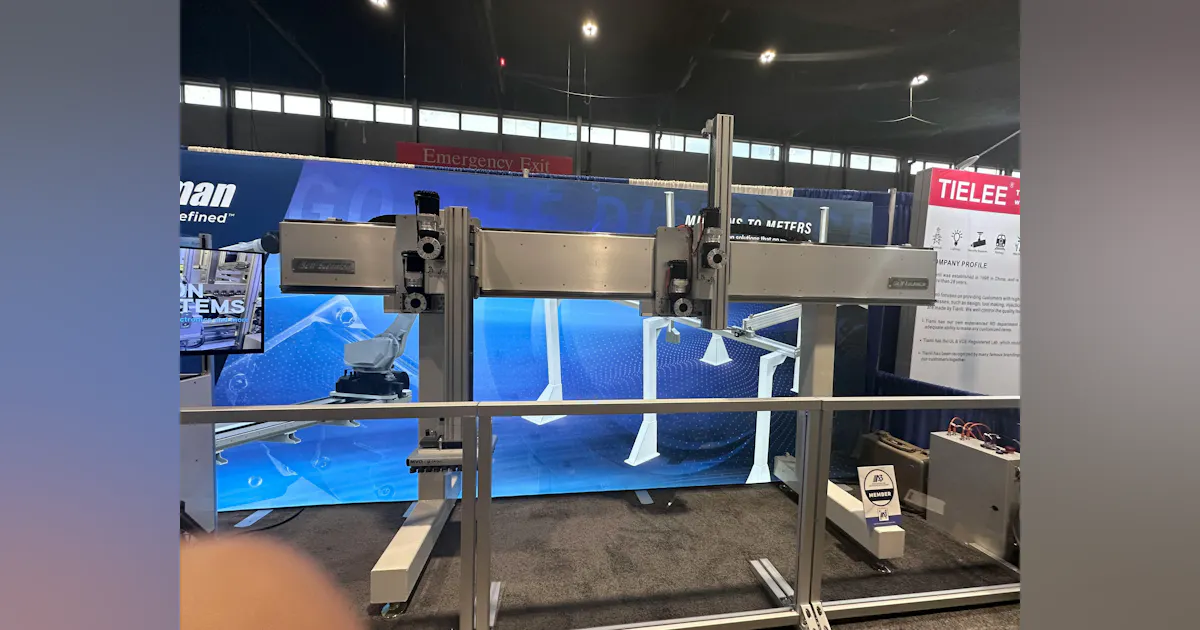
At Automate 2026, a brief circuit of the show floor revealed how advances in motion and automation are unfolding across the industrial stack, from mechanical assemblies to control electronics and precision components. Exhibitors, including Bell-Everman, Copley Controls and KHK USA, emphasized measured, application-driven improvements aimed at extending system performance, easing integration and giving engineers greater latitude in industrial automation and design.
1. Bell-Everman: ServoBelt for Multi-Carriage Automation
Motion-control specialist Bell-Everman showcased its proprietary ServoBelt linear-drive technology, designed to deliver long-travel precision motion without sacrificing stiffness, repeatability or speed.
“We are a manufacturer of precision linear motion stages and rotary stages out of Santa Barbara, Calif.,” said Scott Everman, National Business Director at Bell-Everman. “We’ve been in business for over 30 years building precision motion stages, multi axis systems and this is our flagship product, ServoBelt.”
The company, which develops linear and rotary stages, actuators and custom electromechanical assemblies, says ServoBelt falls into a distinct class of linear motion technology. Unlike conventional belt drives, rack-and-pinion systems and ball screws, the design uses a patented arrangement consisting of a stationary, toothed steel belt that acts as the rack and a recirculating belt assembly integrated into the carriage.
“Many engineers know of the incumbent linear motion technologies of belt drives, rack-and-pinions and ball screws,” Everman said. “ServoBelt is its own category.”
He explained that the system employs “a base belt on the bottom of our stages, a static belt that serves as the rack of our rack and pinion,” while “this entire carriage here can basically be thought of as a different take on the entire pinion.” In the ServoBelt architecture, the stationary toothed belt functions as the rack, while the entire moving carriage assembly effectively performs the role of the pinion.
The carriage houses a recirculating belt that passes around idler bearings and engages with the stationary belt. “When your motor pinion tensions upward, it eliminates backlash by pulling the belt towards the middle of your drive line,” Everman said. According to the company, this arrangement enables the system to maintain stiffness and repeatability over long travel lengths without relying on a conventionally tensioned recirculating belt.
“So, what ServoBelt allows us to [do is] go unlimited travel and without losing any of our repeatability, driveline stiffness or speed capabilities because we don’t have to keep a recirculating belt in tension throughout the travel of our stage,” Everman said. “We are simply adding more of our rack, more of our bearings and more of our chassis to make this the longer travels.
“The other great thing about ServoBelt is the ability to put multiple independently moving carriages on a single track,” he added. The approach enables a single gantry to carry multiple independently controlled end effectors, increasing throughput by allowing several tasks to be performed concurrently. “So, we’re thinking about increasing throughput and using one single system we can add many more end effectors to the same gantry and get the job done a little bit quicker.”
Bell-Everman also emphasized the modularity of its systems, which are built using T-slot aluminum extrusion platforms that can be configured to meet varying load and motion requirements.
“Everything we build is on T-slot extrusion, which gives us a lot of adaptability into every application,” Everman said. “We can decide how many bearing rails we’re using, which size of extrusion, where those bearing rails are placed so we can accommodate different loads and different axis of motion.
“And we build everything on a 20-ft granite slab to keep everything very precise and straight, especially when we are splicing together pieces of our chassis for longer applications,” he added.
Overhead Pick-and-Place Systems
The company also highlighted large overhead pick-and-place systems as a key application area for ServoBelt technology. Such systems often require travel lengths of 20 to 30 m. These applications historically have been assigned to rack-and-pinion systems because of their long-axis capabilities, Everman explained.
Overhead pick-and-place is an area where Bell-Everman’s technology is especially well suited, said Everman. “The ability to go 20, 30 meters worth of travel oftentimes is an application that would have been given to a rack-and-pinion linear motion system.”
He noted that many of these applications do not require the heavy, precision-machined steel structures traditionally associated with long-travel systems.
“Because of that need for extra long length, we have found that there are plenty of applications for overhead pick-and-place where the requirements of the payload don’t warrant a lot of long precision-machined steel,” Everman said. “We utilize an aluminum composite beam that can span seven to eight meters unsupported without seeing noticeable deflection.”
The demonstration system at the booth featured a machine-tending application for automotive manufacturing.
“This application here was moving a 70-lb payload—picking up a 70-lb payload and doing machine tending in and out of lathes, mills, in an automotive application,” Everman said.
He added that a larger version installed at a customer facility handles substantially heavier loads.
“The application in their actual factory is about 750 lb, moving three-and-a-quarter meters per second,” Everman said. “We can really get, you know, a decent amount of payload moving fairly fast and still keep all of that repeatability with our splicing technology, and with the inherent advantages of ServoBelt.”
