


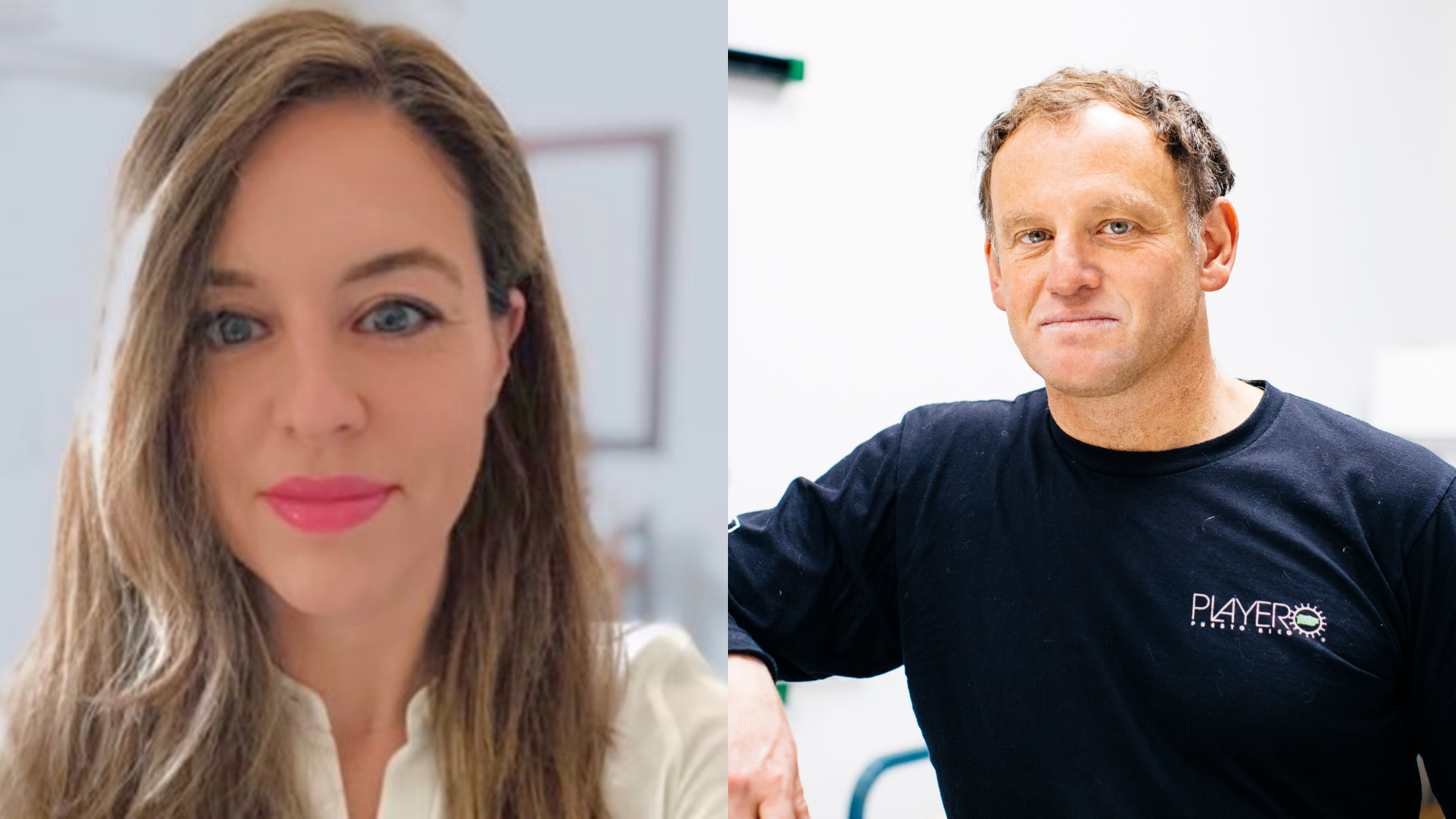
Two University of California, Santa Cruz, professors are recipients of the campus’s Innovation Catalyst grants, providing crucial support to bridging the gap between foundational research and early-stage commercial investment for these promising projects.
UC Santa Cruz’s Innovation Catalyst Proof-of-Concept Program helps move cutting-edge research from the lab out into the world for societal impact. The 12-month program, managed by the Innovation & Business Engagement Hub, provides targeted grant funding, industry mentorship, market research and customer discovery training to help researchers commercially validate their technologies.
Assistant Vice Chancellor for Innovation & Business Engagement Ryan Sharp recognizes that one of the greatest challenges in academic innovation is the “valley of death”—the gap between basic research and commercial readiness.
“Through Innovation Catalyst, we are investing in two of our most valuable assets: our technologies and our researchers,” Sharp said. “By providing a pathway for our faculty and their labs to validate their innovative work and explore its commercial potential, we are not only fostering a more robust innovation ecosystem on campus, but also building capacity in our researchers to help solve the world’s most complex problems.”
This year’s awardees are Assistant Professor of Biomolecular Engineering Vanessa Jonsson and Professor of Physics David Lederman.
Jonsson, together with graduate students Divya Venkatraman and Lydia Mok, is developing a test to detect the presence of multiple viral infections like COVID-19, RSV, and the flu—and a person’s immunity to those infections—all from a single nasal swab.
The nasal-swab tests that became commonplace during the COVID-19 pandemic tested for just a single virus, and determining immunity typically required a blood draw. The new technology aims to close this gap by combining multi-virus detection and immune readouts in a single nasal swab, using scalable technology to show not just whether someone is infected, but where they are in the course of illness or immunity––including past infection or vaccination.
The platform builds on SwabSeq, an efficient diagnostic technology developed under the leadership of UCLA’s Professor of Computational Medicine Eleazar Eskin. This new system, called ImmPrint-SwabSeq, integrates viral detection with immune profiling and includes a clinical dashboard that translates complex molecular data into clear and easy to interpret results.
ImmPrint-SwabSeq can process thousands of nasal swabs in under 24 hours, enabling cost-efficient, high-volume, scalable testing. This speed and scalability allows the platform to support both clinical care and public health efforts, helping track virus spread and immunity across entire communities in near real time. For individuals, the test delivers results into a clear personal readout of infection and immunity––delivered digitally and without a blood draw.
Energy-efficient electronics that “remember”
Lederman, together with graduate student Becker Sharif, is building and testing memristive devices based on novel materials science and related methods to enable radio-frequency switching. This innovation targets critical needs in fields such as communications, medical technology, and avionics—where low power consumption, broad frequency response, and high on-to-off current ratios are essential.
Traditionally, these switches rely on technologies like field-effect transistors and PIN diodes, which require a constant bias current to maintain their switching state. This continuous power draw results in significant energy consumption and creates a heat load, posing a major limitation for battery-powered, portable devices that need to transmit and receive electromagnetic signals.
Memristors, on the other hand, are two-terminal devices that can be turned on and off using voltage signals and retain their state when turned off. This non-volatile property allows for switches that do not require a constant power input to be active.
The researchers aim for their technology to achieve transformative performance gains in radio frequency switching, making them attractive for commercial adoption in applications where fast, high-efficiency, and low-power switching are essential. UC Santa Cruz’s central research office has more information about the technology.
Sustaining these types of valuable technology development programs requires a range of funding sources. This fourth cycle of Innovation Catalyst was supported in large part by the efforts of the UC Santa Cruz Foundation’s Innovation Task Force and Board Innovation Fund. Inspiring Change: The Campaign for UC Santa Cruz amplifies the importance of research frontiers and groundbreaking innovations.
If you would like to learn more about the Innovation Catalyst technologies and how you can help accelerate innovation, please reach out to the Innovation & Business Engagement Hub at hub@ucsc.edu.
